Privacy-Orchestrator
~/boday-it/product
Privacy-Orchestrator
Use AI coding assistance without giving away your domain knowledge
AI models write useful code today. But using them means sending the entire request to the provider: customer names, business rules, rates, internal processes. With regulated data or real company know-how, that is often not acceptable. The Privacy-Orchestrator solves this with a simple principle: no external model ever sees the whole picture.
Architecture
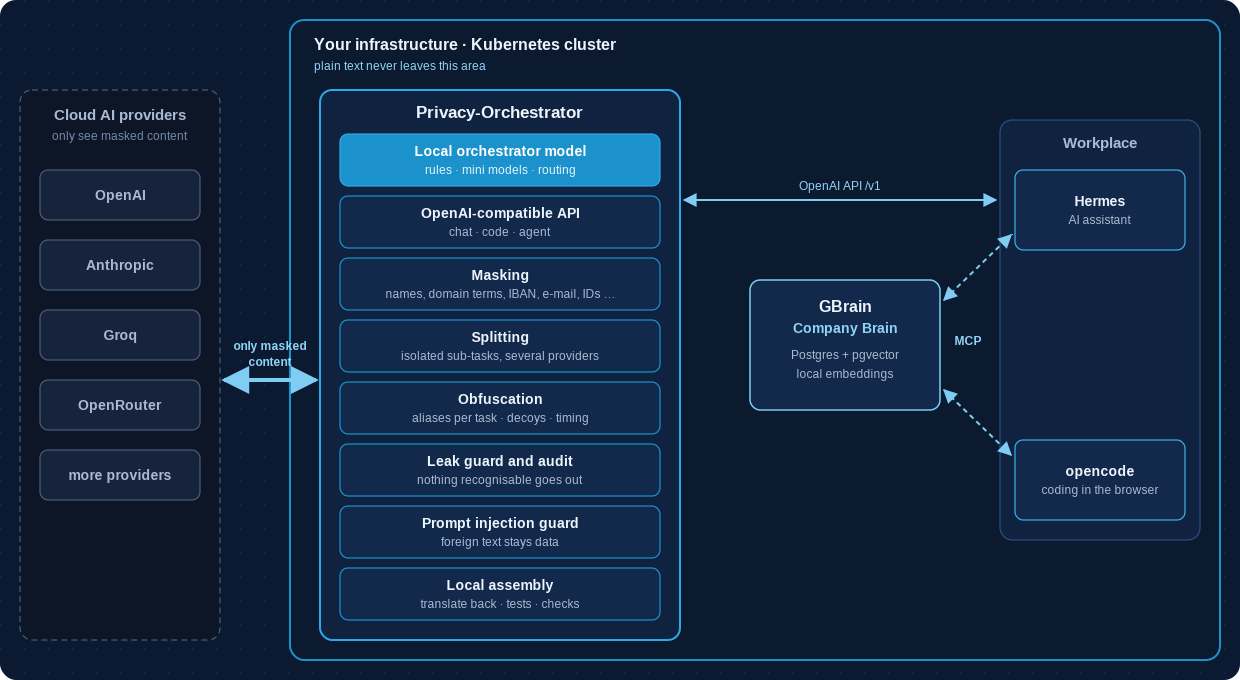
The local model is mandatory. The orchestrator always runs as a local language model on your own infrastructure. It is the only place that sees your requests in plain text – which is why it never belongs to a cloud provider.
- Rules: Fixed detection rules find company and customer names, IBANs, e-mail addresses, social security numbers, phone numbers and access keys – fast, traceable and without any AI.
- Optimised mini models: Small models tailored to a single job handle narrowly defined checking and routing tasks locally, in fractions of a second.
- Local orchestrator model: It understands the request, breaks it down, decides what must be masked and routes it onwards: programming tasks split across several providers, chat and assistant requests masked and sent to a fast model.
- Company Brain: GBrain makes your company knowledge available to Hermes and opencode. The search indexes (embeddings) are built locally as well – company knowledge never leaves your network.
How it works
- Split: An orchestrator model analyses the request and breaks it down into small, independent programming tasks – each one neutral on its own.
- Mask: Domain terms, names and key figures are replaced with neutral placeholders. "Dunning level per customer" becomes an abstract function with generic identifiers. Domain-specific values (thresholds, rates, country codes) stay local and are only filled in during assembly.
- Distribute: The sub-tasks are sent to different AI providers. Each one sees only a fragment, without context and without any link to the others.
- Check: Before anything is sent, a leak scanner looks for original terms, and a second review step looks for domain words that slipped through. Anything that is not clean is masked again or not sent at all.
- Assemble: The answers are translated back, verified with test cases and assembled locally into a working program. A trial run and a comparison with the original request make sure the result does what was asked.
Additional safeguards
- Separate placeholders per sub-task: The same term has a different name in every sub-task – even two requests to the same provider cannot be linked through names.
- Decoy tasks and timing decoupling: Harmless extra tasks in the same style and random delays make it harder to match sub-tasks to a request.
- Separate identities: Dedicated access keys per AI provider and, if required, a separate network route (proxy).
- Approval before sending: On request, the process pauses and shows every outgoing request exactly as it would be sent – with the option to mask additional terms.
- Full transparency: A dashboard shows for every request what went to which provider, which terms were masked, and how much extra time and cost the splitting required.
- Prompt injection protection: Provider answers and files that are read count as data, never as instructions. Comments and free text from providers are removed, suspicious answers are discarded.
- Audit log: Every run is fully recorded – original request, masking table, every outgoing sub-request with provider and model, check results and generated code. The log stays on your infrastructure and is never sent to an AI provider. This lets you prove after the fact what was sent to whom and when – for internal audit, data protection and compliance.
Everyday use
- Works like a familiar AI model: The orchestrator provides an OpenAI-compatible interface. Development tools such as opencode or AI assistants such as Hermes connect directly, without changing your workflow.
- Python and TypeScript: Results as a single, runnable module – including follow-up requests that extend existing code.
- Free choice of models for the sub-tasks: Cloud providers, your own gateways or local language models – individually or combined. The orchestrator itself always stays local.
- Self-hosting: Runs on your own infrastructure or on Kubernetes clusters we operate in Switzerland.
Measured, not just claimed
We tested the Privacy-Orchestrator with six typical business requests – payroll, dunning, medical billing, car insurance, customs clearance and hotel billing – each with sample data and expected results calculated in advance. An AI model then acted as an "attacker" and tried to guess the industry and purpose of the software using only what a single provider got to see.
- Correct results: All 6 generated programs produced exactly the expected values.
- No original terms: Not a single domain term from the requests was sent to a provider.
- From the original request, the attacker model identified the industry in 6 out of 6 cases.
- From a single sub-task, it identified the industry in 0 out of 26 cases.
- From all sub-tasks of one provider combined, it succeeded in 1 out of 8 cases. More providers and decoy tasks reduce this further.
- The price of protection: Splitting takes about ten times longer (just under 30 seconds instead of 3) and requires considerably more compute than a single request.
Measured in November 2026 with freely available models. Full results are available on request.
Our approach: Data minimisation instead of trust. Rather than hoping a provider handles your data carefully, it never gets enough context to infer anything from it. Because the orchestrator always runs as a local model, the plain text never leaves your network.
Who it is for: Companies and development teams who want to benefit from AI-assisted programming but work with confidential business rules, customer data or regulated information – for example in finance, healthcare or public administration.
Interested in a demo or a pilot project? Get in touch with us.